
CBD isolate: what format is it and how to choose oil or concentrate

- 31 August 2026 18:16:00
- Reviews: 0
- Views: 176
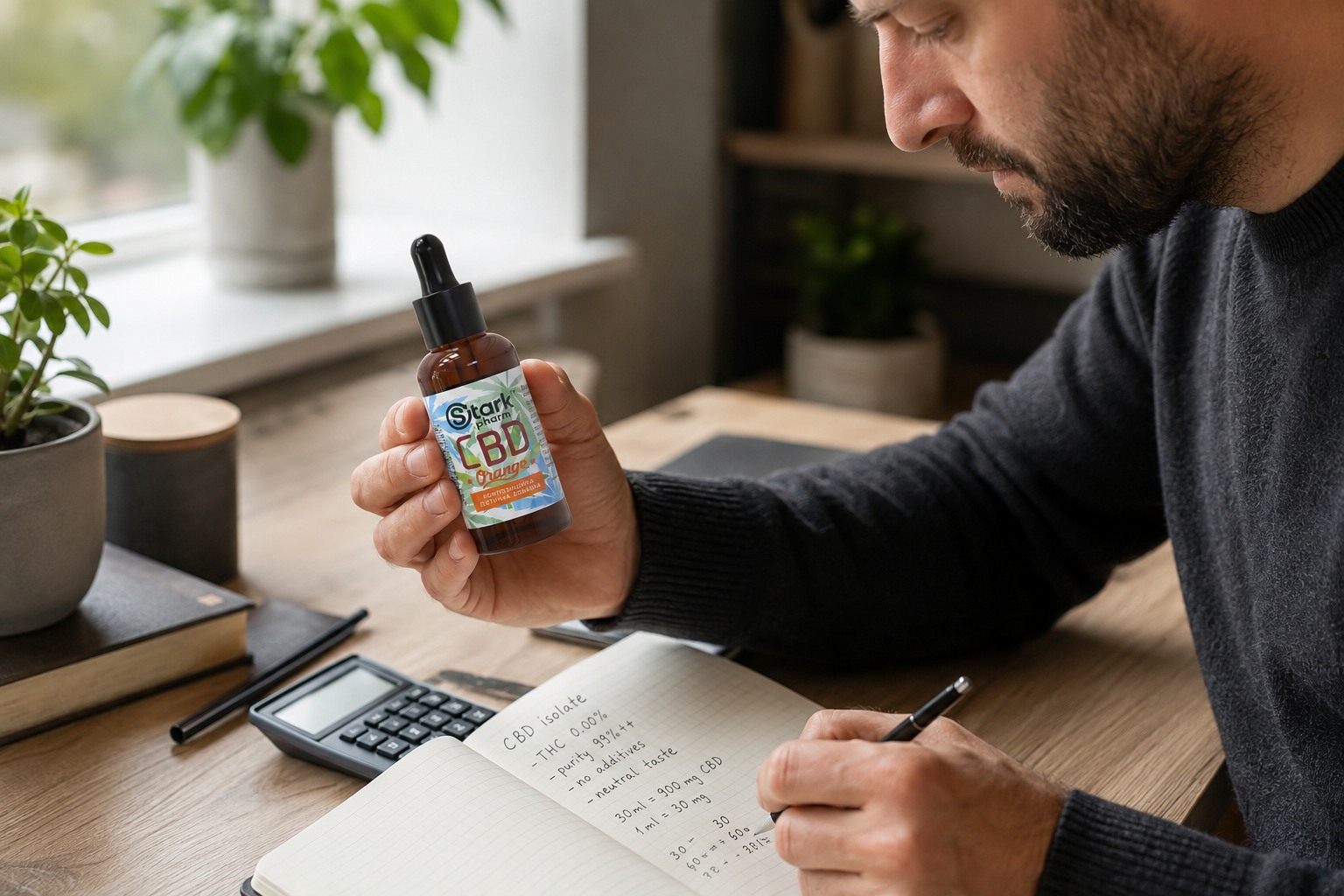
On one page, CBD isolate looks like a concentrate, on another - like oil in a bottle. Hence the simple but frequent puzzle of the buyer: are these different products or the same idea in different formats? The answer takes a minute: isolate describes the type of CBD format, and oil, powder or concentrate tells how the product is presented and how convenient it is to use.
This choice should be made before placing the order. One person needs a clear bottle with the indicated volume, another is more interested in a concentrated format, and someone needs to quickly compare 1000 mg, 1500 mg, 25 mg and milliliters without confusion in numbers. Below is a practical logic that makes it easier to choose a CBD isolate for your scenario, rather than just taking the first name with the word isolate.
What does CBD isolate mean in the catalog?
CBD isolate is the name of a format that buyers often search for as "CBD isolate" or "CBD isolate". In the catalog, it helps to separate such items from other CBD formats, but the name itself does not yet answer all questions about a specific product. To make a choice, you need data from its page: form, amount of CBD in milligrams, bottle volume, method of administration and other specified characteristics.
That is why two products with the same word "isolate" in the name should not be automatically considered interchangeable. One may be presented as a concentrate, another as CBD oil, and the third has its own labeling of the amount of CBD and volume. The buyer does not choose a term for the sake of a term, but a clear format for his usual rhythm.
When you want to start with a broad overview of forms, it is useful to open the CBD concentrates section. It is relevant for those who are looking for a concentrated CBD format and want to compare available positions by name and parameters, rather than mixing them into one conditional category.
Isolate, concentrate and oil: where the difference lies
The simplest rule is this: the word "isolate" refers to the CBD format, and the word "oil" describes the product's presentation in a bottle. Concentrate is a broader commercial term for products with a high concentration of the substance in a small format. Because of this, isolate can be found next to concentrates, and CBD oil isolate can be found in the oils section.
A bottle is usually convenient for someone who wants to see the volume in milliliters and the amount of CBD in milligrams on the label. This option is easier to integrate into a familiar home shelf: the bottle closes, it is easy to store, and the numbers can be quickly compared to another volume.
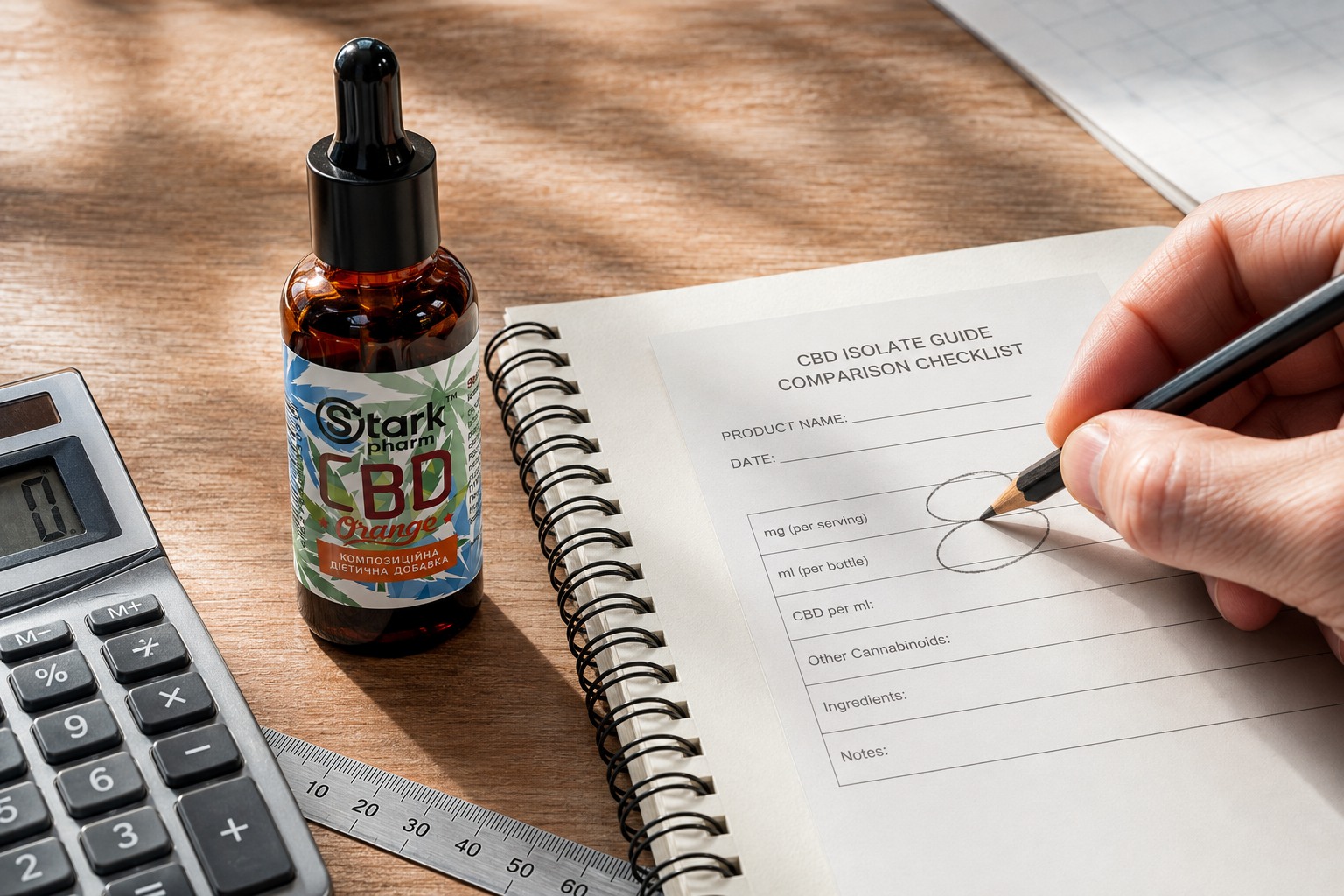
Concentrate is interesting for a different logic of choice. Here, attention shifts to the most concentrated format, the amount of CBD and the method of administration specified by the manufacturer. Do not presume any concentrate to be a powder, paste or oil: the category name does not replace the description of a specific item. The form must be directly indicated on the product page or packaging.
When buyers say "isolate powder"
A search query for powder often arises from the habit of referring to isolate as a dry concentrated product. However, a more precise check is required for purchase. If a person is looking for powder, they should only choose a product where this form is explicitly indicated, and not transfer this assumption to every CBD isolate in the catalog.
On the CBD isolate 1000 mg page, the key reference point is already the specified 1000 mg of CBD. Before choosing, it is worth additionally reading the description of the format and the available data on the page. This way, the buyer will not buy a product with a familiar name, expecting a different texture or method of use.
Why a bottle doesn't make a product "less concentrated"
The oil format does not cancel out the amount of CBD. It simply adds another parameter - volume. The inscription "1500 mg, 30 ml" is read differently than just "1500 mg": the first number shows the total amount of CBD in the bottle, and the second helps to understand how this amount is distributed by volume.
For example, CBD oil isolate 1500 mg explicitly states 1500 mg and 30 ml. Dividing 1500 by 30 gives 50 mg of CBD per ml. This is not a quality assessment or advice on the amount to use, but simple arithmetic that allows you to correctly compare two bottles of different sizes.
How to read mg and ml without unnecessary math
The numbers on CBD oil answer a few different questions. Milligrams, or mg, indicate the amount of CBD listed for the product. Milliliters, or ml, indicate the volume of liquid in the bottle. When both values are listed on the label, you can divide them by each other to get the number of milligrams per 1 ml.
This formula is especially useful when two bottles look almost identical but have different volumes. For example, a higher total amount of CBD does not always mean a higher amount per 1 ml if the volume has also increased. Comparing only the large numbers on the front of the name is a common reason for poor selection.
- mg - total amount of CBD, if stated in the name or description.
- ml - volume of liquid product in the bottle.
- mg/ml - the ratio of the amount of CBD to 1 ml, which is convenient to calculate for comparing oils.
- The quantity in the name without ml is a reason to carefully check the shape of the product, rather than trying to deduce the ratio at random.
The mg/ml indicator is needed for clarity, not for a number competition. Some people prefer a compact bottle with a clearly stated amount of CBD, while others prefer a specific volume. The winning choice starts with the question "what exactly do I want to compare?".
If you need to understand more, the material on how to compare CBD oils by percentage, milligrams, volume, and real price contains the logic of comparing these indicators. Here it is enough to remember the base: the total mg and ml do not duplicate each other, but work together.
Two scenarios: oil in a bottle or concentrated format
Oil is more often chosen by people who like the predictable shape of the bottle and the clear pair “mg + ml”. Such a product is easy to compare with another oil, because both parameters are visible at once. If this logic is important, it is better not to switch to concentrate just because the word sounds stronger.
Concentrate should be considered when the concentrated format itself is a priority and you are willing to carefully check the form of a specific product. There is no universal “better”. There are different habits: one buyer needs a neat bottle, another is interested in a different CBD delivery, and a third already knows exactly what he is looking for in an isolate with a certain number of milligrams.
The phrase “cannabis concentrate” in the search can also lead to a wide range of products, so it is better to specify it. For CBDUA, a more practical guideline would be the specific name of the format: CBD concentrate, CBD isolate or CBD oil isolate. This way, the search does not replace the actual parameters of the product with a general word.
An option for those who need a volume of 30 ml
The name Stark CBD Isolate 25 mg indicates 30 ml of cannabidiol oil. This is an example of why the name should be read in its entirety: it includes the isolate format, the 25 mg value, and the volume of the bottle. You should not automatically equate this 25 mg to the total amount in other products until you have checked what exactly this designation on the page refers to.
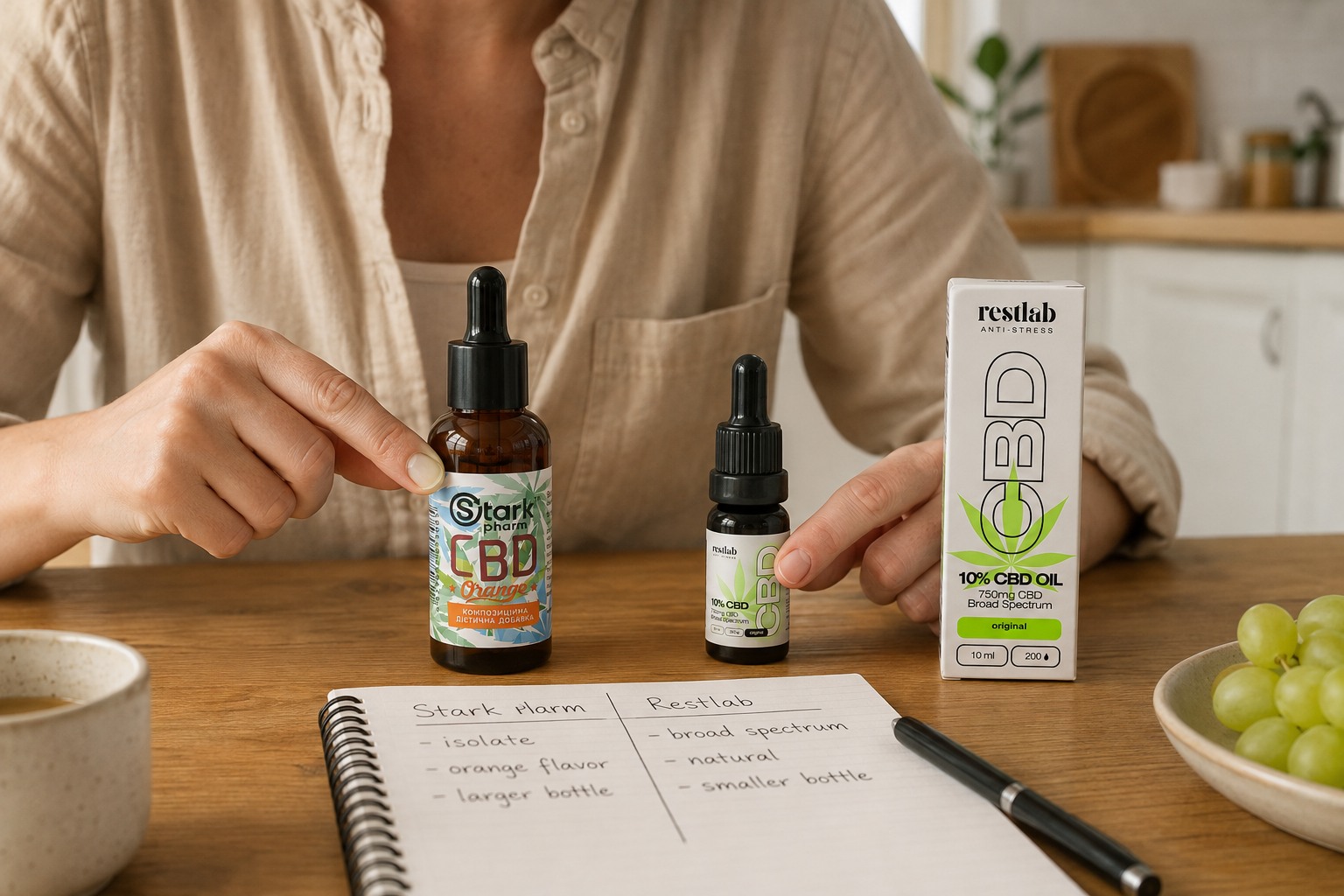
This choice may be of interest to a buyer who is looking for a 30 ml oil format and wants to first check all the data in the description. The comparison will only be fair with a product for which the format, volume and amount of CBD are also clearly indicated.
What to check before buying CBD isolate
It takes a few minutes to make a good choice, if you don't try to make it based on one word in the name. First, determine the form you need. Then compare the amount of CBD and, if it's oil, the volume in ml. After that, it makes sense to look at the other differences listed on the page.
- Do you need the oil in a bottle or are you looking for another concentrated format?
- How many CBD in milligrams is listed for the product.
- Is the volume in ml and can the mg/ml ratio be calculated?
- Are you confusing the total amount of CBD with the per ml figure?
- Does the description confirm the exact form you are planning to purchase?
It is especially helpful to open two or three relevant pages in separate tabs and compare the names line by line. This is easier than relying on memory. In one case, the decisive factor may be 1500 mg and 30 ml, in another, the isolate format and a different indication of the amount of CBD.
Common mistakes when comparing
The first mistake is to believe that the word "isolate" answers the question about everything. It does not replace information about the form, volume and specific amount of CBD. The buyer can look for CBD isolate to buy, but the final choice should be made between the clear parameters of specific items.
The second mistake is to compare 1000 mg to 1500 mg without volume. If one product is 30 ml and the other is in a different format or volume, directly comparing large numbers only tells part of the story. For oils, count mg/ml, and for other forms, check what is explicitly stated in the specifications.
The third mistake is to call any CBD concentrate a powder. The form affects the convenience and handling of the product, so you shouldn't guess it by category. If a dry texture is essential, look for direct confirmation; if you want a bottle, focus on oil positions with the specified volume.
Another small but helpful step: Don't take the number in the name out of context. 25 mg, 1000 mg, and 1500 mg can be important guidelines, but their meaning needs to be read in conjunction with the name, shape, and volume. That's where numbers start to help, not confuse.
How to choose your option without rushing
Start with one solution. If you need a bottle, look at CBD oil isolate and compare mg, ml and mg/ml. If you are interested in a concentrated product, go to the concentrates category and check the form of each item. If there is already a guideline of 1000 mg or 1500 mg, don't stop at the number - read the full name and description.
For a buyer who wants exactly the oil with the specified 1500 mg and a volume of 30 ml, the logical point of comparison would be CBD oil isolate 1500 mg. For someone who is looking for a product with the name CBD isolate 1000 mg, it is appropriate to start with the corresponding position and clarify its format. And for those who are choosing between different concentrated solutions, it is better to first review the category, and only then narrow down the choice.
There is no need to turn the choice into complex chemistry. It is enough to see the difference between isolate as a format, oil as a delivery method and concentrate as a category, and read the numbers in conjunction with the volume. Open the option that suits your scenario, compare its parameters, and the decision will be much calmer and more accurate.