
How to read a CBD label: total mg, volume, and mg/ml

- 18 September 2026 06:41:00
- Reviews: 0
- Views: 116
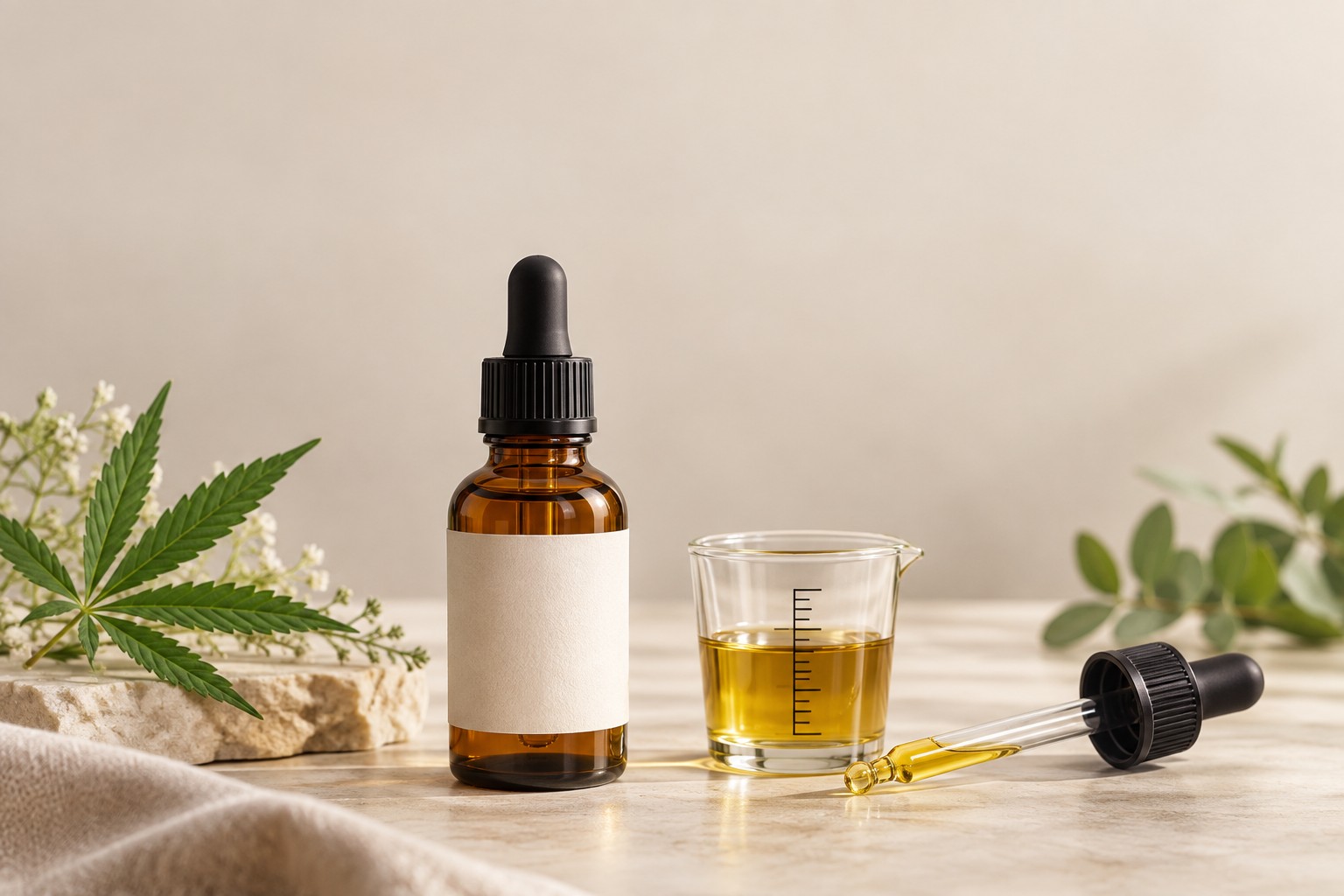
The bottle says “1000 mg CBD,” but next to it is the volume of 10 ml, 20 ml, or 30 ml. This is where the confusion often arises: the large number in milligrams indicates the total amount of CBD in the entire product, not the amount in each milliliter. To correctly compare two bottles, you need to look at at least three labels: total mg, volume in ml, and concentration mg/ml.
The short answer is simple: total mg answers the question of how much CBD is claimed in the entire bottle; ml shows its volume; mg/ml helps to compare the saturation of different formats. This arithmetic does not determine the individual method of use, but it eliminates errors when comparing labels.
Three numbers on the label that should not be confused
A CBD product label may include the name, ingredients, flavor, volume, cannabinoid designation, and other details. For basic comparisons, numerical data is the most useful. It is easy to read if you divide the information into three levels.
- Total CBD in mg - how many milligrams of CBD are claimed in the entire bottle, jar, or other unit of product.
- Volume in ml - how much liquid the package contains.
- Concentration in mg/ml - how many milligrams of CBD are in 1 ml of product.
For example, the words “500 mg CBD” and “10 ml” are not duplicates. The first number indicates the total amount of CBD, the second the volume. By comparing them, you can calculate the concentration: 50 mg/ml.
This approach is especially useful when two items have the same amount of CBD but different volumes. A 500 mg in 10 ml bottle and a 500 mg in 30 ml bottle contain the same claimed total amount of CBD, but their concentration per 1 ml is three times different.
What does the total amount of CBD in milligrams mean?
The designation 300 mg, 500 mg, 1000 mg, or another number next to CBD usually describes the claimed amount of cannabidiol in the entire contents of a particular package. This is a convenient indicator when comparing products of the same format and volume.
For a practical example, open the CBD Oil Isolate 25% in a 10 ml bottle listing. Check the volume, concentration label and ingredients separately, then read them together when comparing labels.
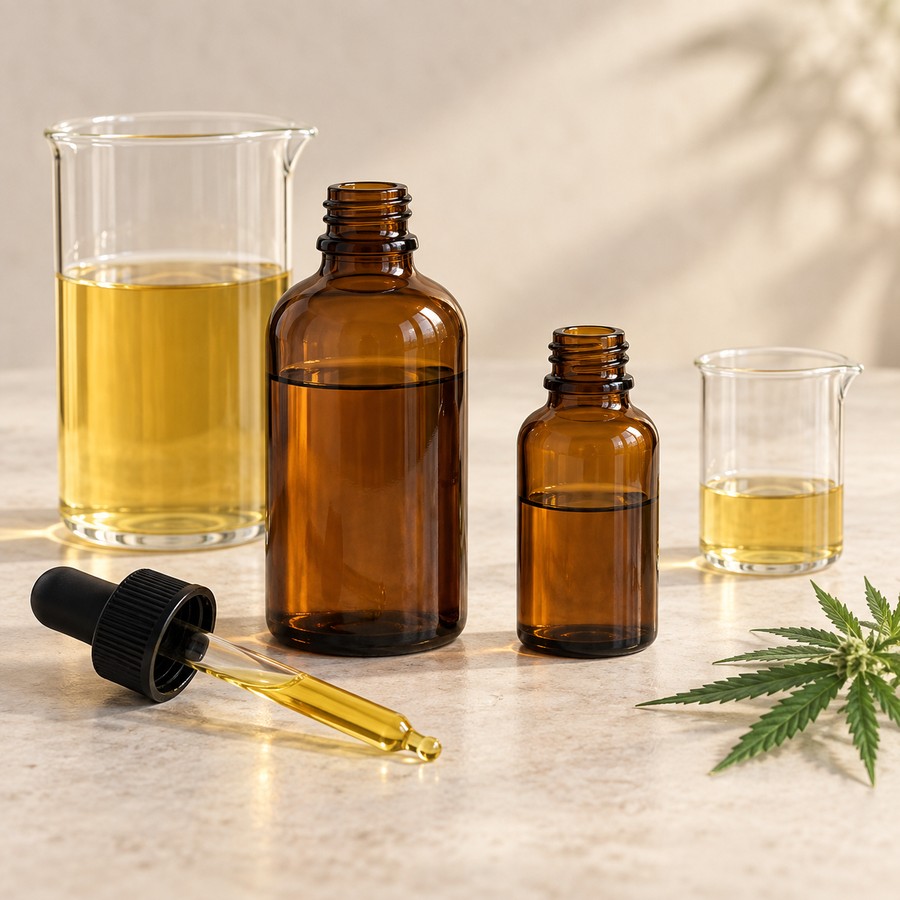
However, the number on the front doesn’t tell the whole story without the volume. A 1000 mg CBD bottle can be compact and concentrated, or larger in volume with a lower volume of 1 ml. The inscription “1000 mg” itself does not automatically mean that the product is in any way “better” than the option with the lower number. It only captures the total amount of CBD claimed.
Why a large number doesn't always explain the difference between products
Let's imagine two hypothetical examples. The first bottle contains 600 mg of CBD in 10 ml, and the second - 900 mg in 30 ml. In the second bottle, the total amount of CBD is higher, but the concentration in the first is 60 mg/ml, and in the second - 30 mg/ml.
If you only look at 900 mg, you might miss this difference. So, total milligrams should be considered as one part of the label, not the only criterion for choosing.
Volume in ml: what it really shows
The ml designation stands for milliliters, which is the volume of liquid in the bottle. It does not indicate the amount of CBD per se. The same volume can contain different amounts of the claimed CBD, depending on the specific formula.
Volume is important for comparing strengths and understanding product format. For example, 10 ml is not a “strength” but an amount of liquid. Just because two bottles say 10 ml doesn’t mean they have the same CBD content.
Sometimes shoppers see a larger package and assume it must contain more CBD. In reality, the larger volume could be the result of a different formulation, added base, or simply a different format. You need to check both the mg and ml numbers.
What changes when CBD-free volume is added to a product
The pure arithmetic here is this: if the total amount of CBD remains the same and the volume increases, the mg/ml concentration decreases. This is not a quality assessment or a recommendation for use. It is simply a ratio of the amount of substance to the volume.
For example, 300 mg of CBD in 15 ml equals 20 mg/ml. If the total volume of the same mixture becomes 30 ml and the amount of CBD remains at 300 mg, the calculation gives 10 mg/ml. The total milligrams are the same, but there are fewer per milliliter.
How to calculate mg/ml yourself
The formula is short: total amount of CBD in mg / volume in ml = CBD concentration in mg/ml .
No need to look for a complicated calculator. Just take the CBD number from the label, divide it by the specified volume, and round the result to a convenient value. The calculation is needed for comparing labels, not for creating individual schemes.
Example with round numbers
A bottle contains 500 mg of CBD and has a volume of 10 ml. We calculate: 500 / 10 = 50. Therefore, the calculated concentration is 50 mg/ml.
The other bottle contains 500 mg of CBD in 20 ml. We calculate: 500 / 20 = 25. Here the concentration is 25 mg/ml, although the total amount of CBD in the two bottles is the same.
Example when the result is a fraction
The label says 1000 mg CBD and 30 ml. Calculation: 1000 / 30 = 33.3. That is, one milliliter contains approximately 33.3 mg of CBD.
A small result is not a problem. The "approximately" designation is appropriate because the number after division often has many decimal places. For a clear comparison, one decimal place is usually enough.
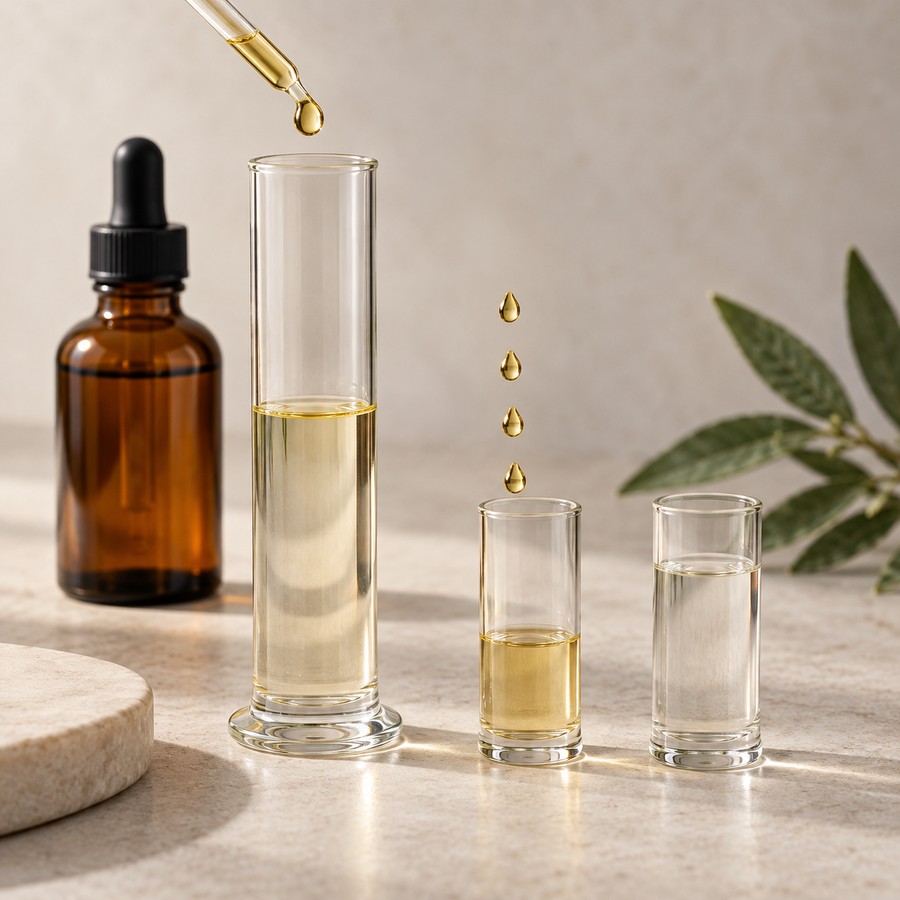
How to Compare Two CBD Vials Without Confusion
It is most convenient to compare labels in the same order. First, check which component is listed on the package. Next, look at the total mg, the volume in ml, and only then at the ready-made or self-calculated mg/ml value.
- Make sure the mg figure refers to the CBD itself, not the total weight of the product or any other metric.
- Find the total volume of the bottle in ml.
- Divide the total mg of CBD by ml if the manufacturer has not listed the concentration separately.
- Compare the same units of measurement: mg with mg, ml with ml, mg/ml with mg/ml.
- Check the composition and format if two products have similar numbers but differ in purpose or method of use.
This order protects against the common mistake of comparing 1000 mg of one product to 50 mg/ml of another as if they were the same quantity. In fact, the first number describes the entire bottle, the second - one milliliter.
When the label has mg per serving
Sometimes, the manufacturer will also list the amount of CBD per serving. This is a third type of number, and it should also not be confused with the overall mg and mg/ml. The per serving designation depends on how the manufacturer defines one serving in their product.
For liquid formats, this information may be provided alongside the total volume or number of servings. For capsules, chewables, and other packaged formats, the label may indicate the amount of CBD per unit and the total number of units in the package.
The check is simple: multiply the stated mg per serving by the number of servings. The result should be consistent with the stated total amount of CBD. If the information on the label is missing or the wording is unclear, it is more correct not to guess the meaning, but to clarify the data in the description of the specific product.
Common Mistakes When Reading CBD Labels
Consider mg/ml as the total amount of CBD
The inscription "25 mg/ml" means the concentration per milliliter. To understand the total amount of CBD in the bottle, you also need the volume. In a 10 ml bottle, this would correspond to 250 mg in total, and in a 30 ml bottle - 750 mg.
Evaluate a product only by the number on the front label
The large milligram label is eye-catching, but without the volume, it doesn't allow for a fair comparison of concentration. Look for the smaller ml label first. It often explains why two products with similar numbers are different.
Confusing CBD with other ingredients in the formula
The packaging may contain names of other substances, botanicals, fragrances, or base names. Not every number next to the ingredient indicates the amount of CBD. For your calculation, only use the value that the label directly refers to CBD.
Perceive concentration as a medical characteristic
Mg/ml is a mathematical ratio, not a promise of a specific result. It helps to read labels and compare products transparently, but does not describe individual sensations or health effects.
What else to check besides mg, ml and mg/ml
Numbers are important, but the label is not limited to them. Before choosing, it is worth reading the product name, list of ingredients, format, date and other information provided by the manufacturer. This helps to avoid comparing things with different purposes.
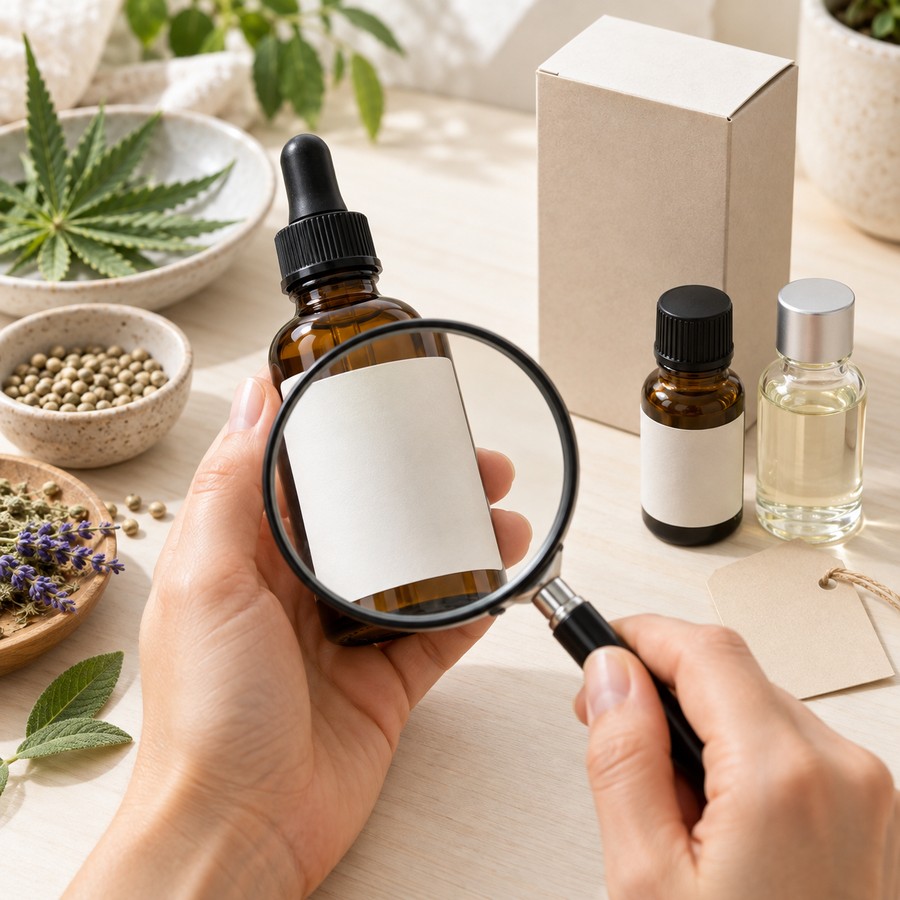
Please note whether this is a finished product or a component for a specific configuration. If the product consists of several parts, the total CBD amount and total volume should be calculated for all selected components together. Adding a component with CBD increases the total mg, while adding a neutral volume without CBD primarily changes the mg/ml ratio.
It is also useful to check if there is a decoding of the marking on the product page. You should not transfer characteristics from another line, even if the names or numbers are similar. The label of a specific product and its current description should be the basis for comparison.
Practical CBD Label Cheat Sheet
See “750 mg CBD, 15 ml”? Divide 750 by 15 and you get 50 mg/ml. See “50 mg/ml, 30 ml”? Multiply 50 by 30 to get 1500 mg of CBD in the entire bottle.
If you are comparing two options, write down the three values next to each other: total mg, volume ml, mg/ml. After that, the numbers become clear even without complex explanations. One product may have a smaller total volume but a higher concentration, while the other may have a larger volume and more total milligrams.
The rule of thumb is: total mg shows the amount of CBD in the entire package, ml shows the volume, and mg/ml shows their ratio. Read these together, not separately. Then the label stops being a set of numbers and becomes a normal guide for conscious comparison.
What are the calculations in the material based on?
All of the examples above are based on the basic arithmetic formula of "milligrams divided by milliliters." They are for illustrative purposes only and are not intended to be an assessment of the quality of specific CBD products, a recommendation for use, or a conclusion about health effects.
For label examples, compare the total CBD amount and bottle volume in the CBD oil listings.